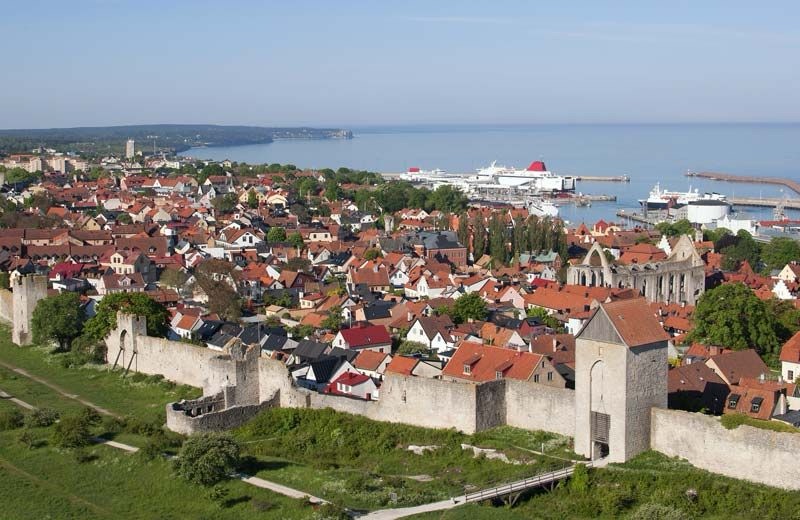
This August, my husband and I will travel to Gotland- Sweden’s storied island in the Baltic Sea- for Medieval Week in Visby, a celebration of history so immersive it borders on time travel. For one week, Visby sheds the present and becomes something else entirely: a living city of the 14th century. The medieval wall that still encircles it no longer seems decorative; it becomes real again. Swordplay, monastic chants, lectures on medieval law, and candlelit markets all fold the past into the present.
But for me, this journey isn’t only about re-enactment. It’s a homecoming, albeit one a thousand years in the making.
Just outside Visby, on the western coast of Gotland, is the small village of Fröjel. Today, it’s quiet- modest farms, a stone church, a view of the sea. But a millennium ago, it was a vibrant Viking settlement and trading port, part of the maritime web that connected Scandinavia to the broader medieval world. Fröjel is also where two of my ancient ancestors- known to science as VK429 and VK58 were buried.
These designations come from the 2019 “Viking DNA” study, one of the most expansive genomic projects of its kind. Using DNA extracted from archaeological remains, researchers uncovered not only population patterns across Viking Age Europe, but also personal links to living descendants. Through this work, I learned that I am directly connected to these two individuals: VK429, a woman of possible social standing, and VK58, a young man whose genetic profile speaks to both deep local roots and continental interactions.
The irony of discovering these ancestors through cutting-edge genetics, only to then seek them out through medieval pilgrimage, is not lost on me.
We know little about their lives. We know they lived, died, and were buried on Gotland. We know their DNA. But we do not know their names, their voices, or the shape of their joys and sorrows. Still, the invitation they extend across time is unmistakable. I plan to visit Fröjel Church, which has stood for centuries near their burial site, and spend time in the cemetery- not just to honor them, but to contemplate the mystery of human continuity.
This entire journey, in fact, is about that continuity. About how the past presses against the present, not as something dead and gone, but as something breathing alongside us. Medieval Week is festive and performative, yes- but it is also deeply intellectual. It’s a space where public history meets academic rigor, where historical fiction and archaeological fact meet in dialogue.
To celebrate this convergence, I’ll be sharing a daily Visby fact in the lead-up to our trip- each one a small fragment of the island’s remarkable story: from its Hanseatic legacy and monastic ruins to its Viking-age burial grounds and enduring oral traditions.
I’m drawn to Gotland for its drama, its beauty, and its imagination. But more than anything, I’m drawn there because it reminds me that history is not something we look back at- it is something we walk through.
And sometimes, if we listen closely, it walks with us.
Photo credit: Brittanica.com

 Swedish Wanderlust