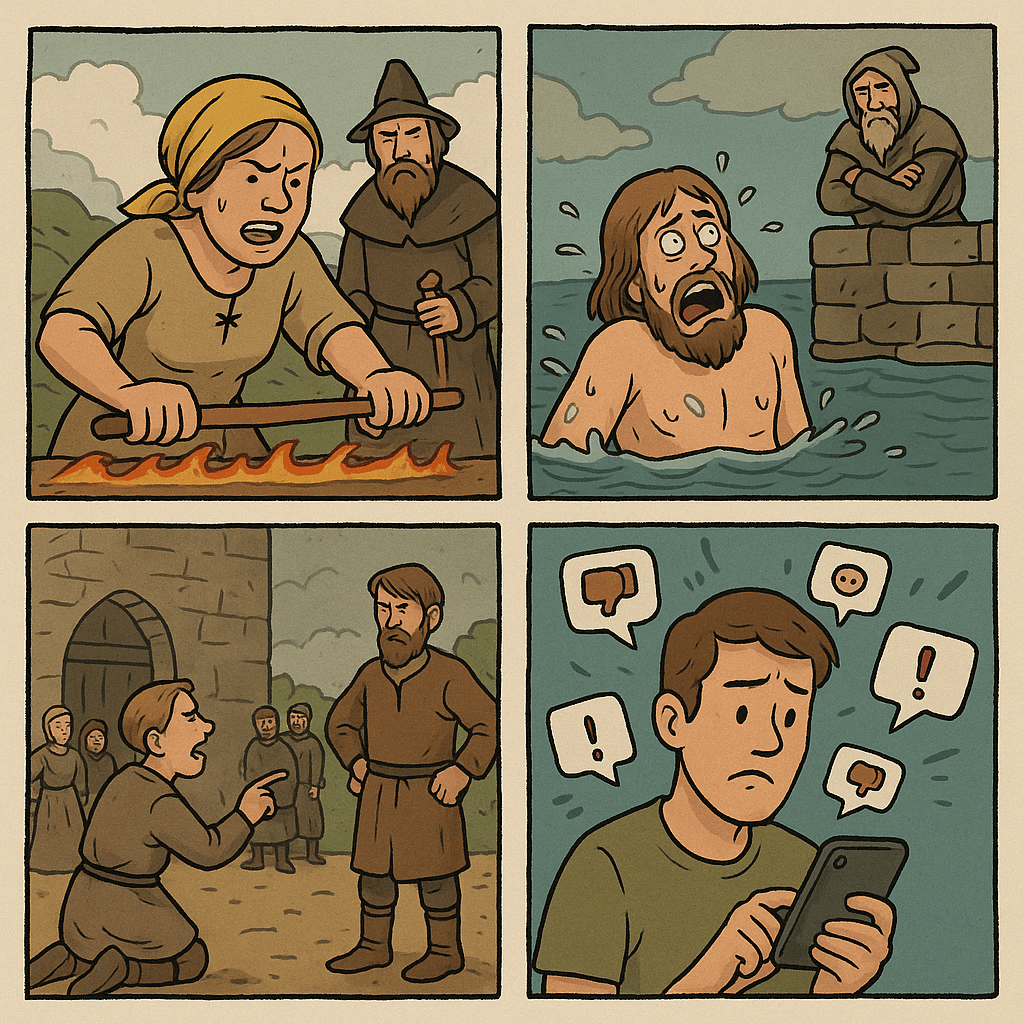
Let’s say it’s the year 1297. You’re in Gotland. Someone’s goat has gone missing. A neighbor’s child is sick. You made eye contact for too long. Congratulations: you’re now under suspicion for sorcery, dishonor, or worse — being different.
Now, how do you prove your innocence?
Easy.
You don’t.
You survive a test and let God (or the gods, depending on the decade) sort it out.
In medieval Gotland — a place where old Norse honor codes and incoming Christian law clashed like swords in a saga — justice wasn’t blind. It was blazing, bleeding, and wildly theatrical.
🧤 Trial by Iron
You’re handed a red-hot iron bar and asked to carry it a few paces. Bandage the burns. Come back in three days. If your wounds are clean, you’re innocent. If they’re infected… well, so are you.
🔥 Trial by Fire
Walk barefoot across glowing coals. Still have skin on your soles afterward? Congratulations, the gods smile upon you. If you limp? Witch.
🌊 Trial by Water
They throw you into the sea. If you float, you’re in league with the devil. If you sink, you’re pure — and hopefully someone fished you out in time to enjoy that status.
💀 Trial by Reputation
Some didn’t need fire or water. A man could be declared a nidingr — a coward, traitor, or oath-breaker — and be exiled or killed without a trial at all. Your character was your currency, and if it was tarnished, your life was forfeit.
Gotland, like much of medieval Scandinavia, walked a strange legal tightrope — balancing centuries of pagan codes rooted in honor and kinship with the creeping weight of canon law.
Sometimes it was communal and symbolic:
🪵 A woman might “sweep out” her shame with a ritual broom.
💧 A priest might bless a well before someone drank from it in hopes of curing spiritual rot.
💍 Accused lovers might swear innocence on a saint’s relic — which, let’s be honest, was just medieval polygraphing with bones.
But let’s be clear:
This wasn’t about truth. It was about belief. Power. Control. Fear.
If justice was a performance, the accused was expected to bleed believably.
We shake our heads at it now.
But then we post screenshots instead of iron brands.
We float reputations in digital trials.
We ask the court of public opinion to decide guilt from a single out-of-context moment.
And like the old rituals — it often ends in fire.
As I get closer to Visby, I wonder how many quiet stones once watched these dramas unfold. How many ghosts still remember the heat of coals underfoot, or the cold clarity of being thrown into the sea to prove a point?
It’s easy to judge the past.
Harder to admit how much of it still echoes in us.
Swedish Word of the Day: rättvisa (noun) – justice
(Rättvisa är inte alltid rätt. Ibland är den bara gammal och högljudd.
– Justice isn’t always right. Sometimes it’s just old and loud.)

 Swedish Wanderlust