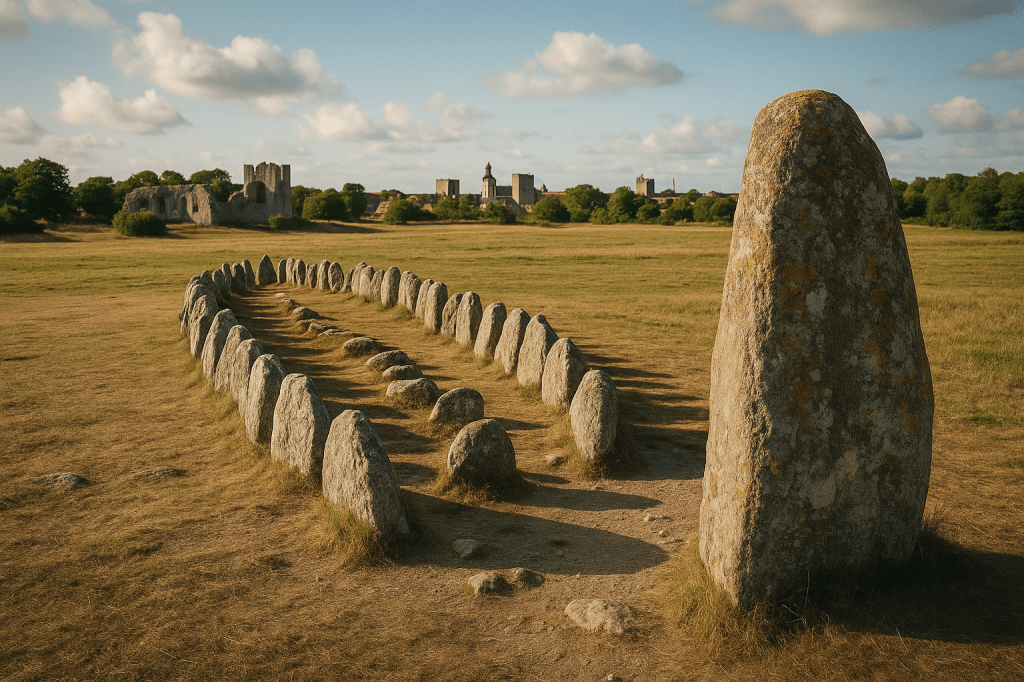
There are 24 days until Visby, and this trip has begun to feel less like a vacation and more like a homecoming — to a place I’ve never been, but somehow already know. I’m not just going to Gotland. I’m returning to something older than memory.
I carry with me a question that started in my DNA results and unraveled into something larger:
What happens when your ancestors are not just historical… but buried in the land you’re about to walk?
🧬 The DNA That Brought Me Here
Through 23andMe, I learned I carry mitochondrial haplogroup J1c8 — a rare maternal lineage passed from mother to daughter over thousands of years. This lineage likely emerged in the Neolithic, traveled north through Europe, and rooted itself in the Viking world.
When I explored open-source Viking DNA studies — especially the 2020 Margaryan et al. genome paper — I learned that some ancient individuals from Gotland and Estonia share key markers that closely match my own J1c8 haplogroup.
🪦 Four Ancestors, One Thread
Based on reanalysis of raw genome data by independent genetic genealogists, four individuals buried over 1,000 years ago appear to share my maternal line:
⚓ VK429 – Fröjel, Gotland
A woman buried near a harbor settlement and early Christian site in the 10th century. She likely lived at the intersection of two worlds — the old Norse faith and the new church. Her DNA shares key mitochondrial markers with mine.
💍 VK58 – Gotland
Buried with jewelry and status, VK58 is another Viking-age woman from Gotland whose genome closely resembles mine at key maternal loci.
🛶 VK489 – Salme, Estonia
One of the warriors buried in the Salme ship. Likely from Gotland, he died far from home around 750 CE. His isotopic signature traces him to Sweden, and his mtDNA belongs to the broader haplogroup J — possibly J1c8.
⚔️ VK554 – Salme
Possibly VK489’s brother. Also believed to be from Gotland, buried in the same ship. His mtDNA also falls under haplogroup J.
🔍 What the Science Really Says
To be clear:
The original published studies do not confirm that these individuals carry J1c8.
Their full mitochondrial subclades were not included in the academic data.
However, their raw DNA sequences have been independently reanalyzed by genetic genealogists. Using tools like HaploGrep, they’ve identified mitochondrial markers matching my own J1c8 profile — markers like A11251G and T14798C, which are rare and distinctive.
This doesn’t make the connection official. But it does make it very likely. And for me, it makes it real.
🛡️ What I’m Walking Toward
Soon, I’ll be on Gotland — walking through Fröjel, standing at the edge of the Baltic, tracing the same coastline these people once knew. I’ll breathe the same salt air, stand on the same stone soil.
VK429 and VK58 were likely women like me — curious, strong, and deeply woven into their communities.
VK489 and VK554 sailed from Gotland to Salme and never returned. The ship that carried them became their coffin. Their burial was respectful, even reverent — but the cause of their deaths remains a mystery.
Their voyage ended in Estonia. Mine begins in Sweden.
But we’re part of the same thread.
🌊 A Living Lineage
We tend to think of the past as separate — entombed in textbooks and soil. But it’s not. It’s still alive. It walks in our cells and speaks through our breath.
My ancestors are not lost to time. They are mapped in me.
Every step I take in Gotland is a return, a reckoning, and a quiet honoring of the lives that made mine possible.
I will go to their land as a daughter does — not to claim it, but to remember.
🇸🇪 Swedish Word of the Day: 🧬 Urmoder (noun) – literally “original mother” or “foremother”
Usage:
“Vi bär våra urmödrars blod i våra ådror.”
(“We carry our foremothers’ blood in our veins.”)
Footnote:
VK429, VK58, VK489, and VK554 are not officially confirmed as J1c8 in published research. Their connection to my maternal lineage is based on independent reanalysis of their raw DNA using haplogroup-detection tools and comparative SNP data. As scientific methods and datasets continue to evolve, these links may someday be formally validated — but even now, the ancestral pattern is clear.
Where to Find Your Ancient DNA Matches:
• 23andMe – Historical DNA Comparisons
Get insights into your ancestry and explore some ancient connections through 23andMe.
• MyTrueAncestry – Deep Dive into Archaeogenetics
Want a more in-depth look at how your DNA compares to actual archaeological remains? MyTrueAncestry offers detailed matches to ancient populations and real burial sites.
🧬 Try a basic analysis for free: mytrueancestry.com/en/

 Swedish Wanderlust