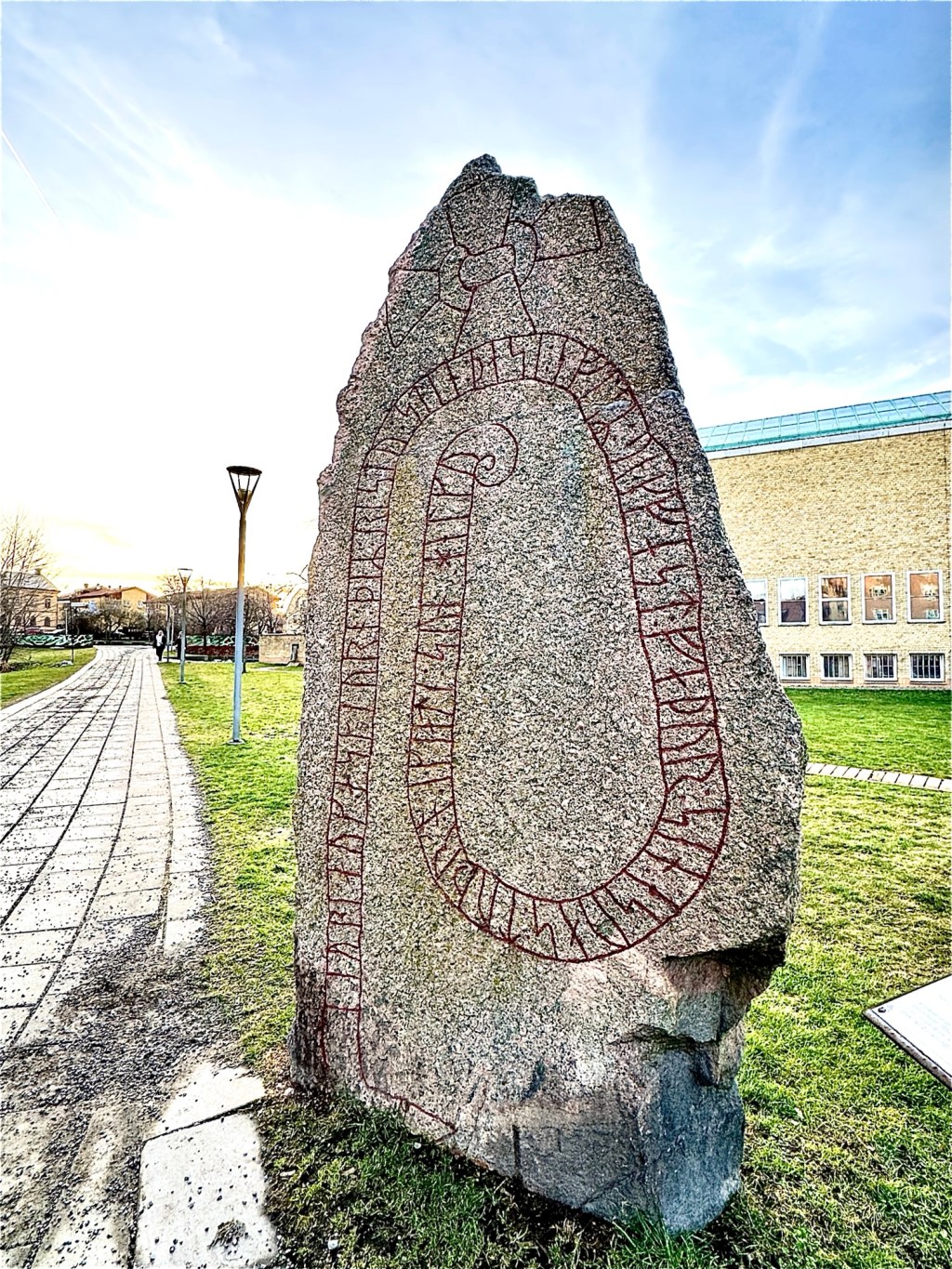
Just outside the Östergötlands Museum in Linköping stands a massive granite monolith, weathered by a thousand winters but still whispering its message across the centuries. It’s known by scholars as Ög Fv1950;341—but it wasn’t always standing tall where it is now.
This stone was once lost to time, buried face-down in the soil of a farm called Kallerstad on the outskirts of Linköping. It was discovered in 1950 during road work—broken, forgotten, and repurposed as mere construction material. But its surface bore something extraordinary: carved serpents and runes, the elegant script of a Viking Age memorial.
When archaeologists began their careful work, they realized what they’d found wasn’t just a relic—it was a voice from the early 11th century.
The inscription, when translated from Old Norse runes, tells a deeply human story:
“Tóki raised this stone in memory of his father who died in England.”
That’s it—simple, stark, and devastating. A son mourning a father lost on foreign soil. Maybe the father was part of the infamous Viking expeditions to England, or one of the many who joined King Cnut’s conquest. Either way, it speaks of love, loss, and a world far more connected than we might imagine.
But why do these stones exist at all?
In Viking Age Scandinavia, runestones were more than gravestones. They were public declarations—of grief, of family, of status, of faith. Set along roadsides or near gathering places, they were meant to be read by all who passed. They declared: “This man lived. He mattered. Let no one forget.”
As Sweden Christianized, crosses began to appear alongside the old pagan symbols. And the serpents—the dragons that wrap around the runes—are not just decoration. In Norse mythology, serpents guarded memory, coiled around the world itself. To carve your sorrow into a serpent was to give it permanence, power, and perhaps even protection.
After its discovery, the Kallerstad runestone was carefully restored and moved to the front of the Östergötlands Museum—a fitting place for a piece of the past that refused to stay buried.
Today, it stands under open sky, framed by the hum of modern Linköping. Students, tourists, and locals walk past it every day. Some stop. Some don’t. But for those who pause, the stone still speaks. Of journeys. Of fathers and sons. Of how even in the 11th century, Östergötland had ties far beyond Sweden’s borders.
It’s not just a rock.
It’s a memory someone fought not to lose.

 Swedish Wanderlust