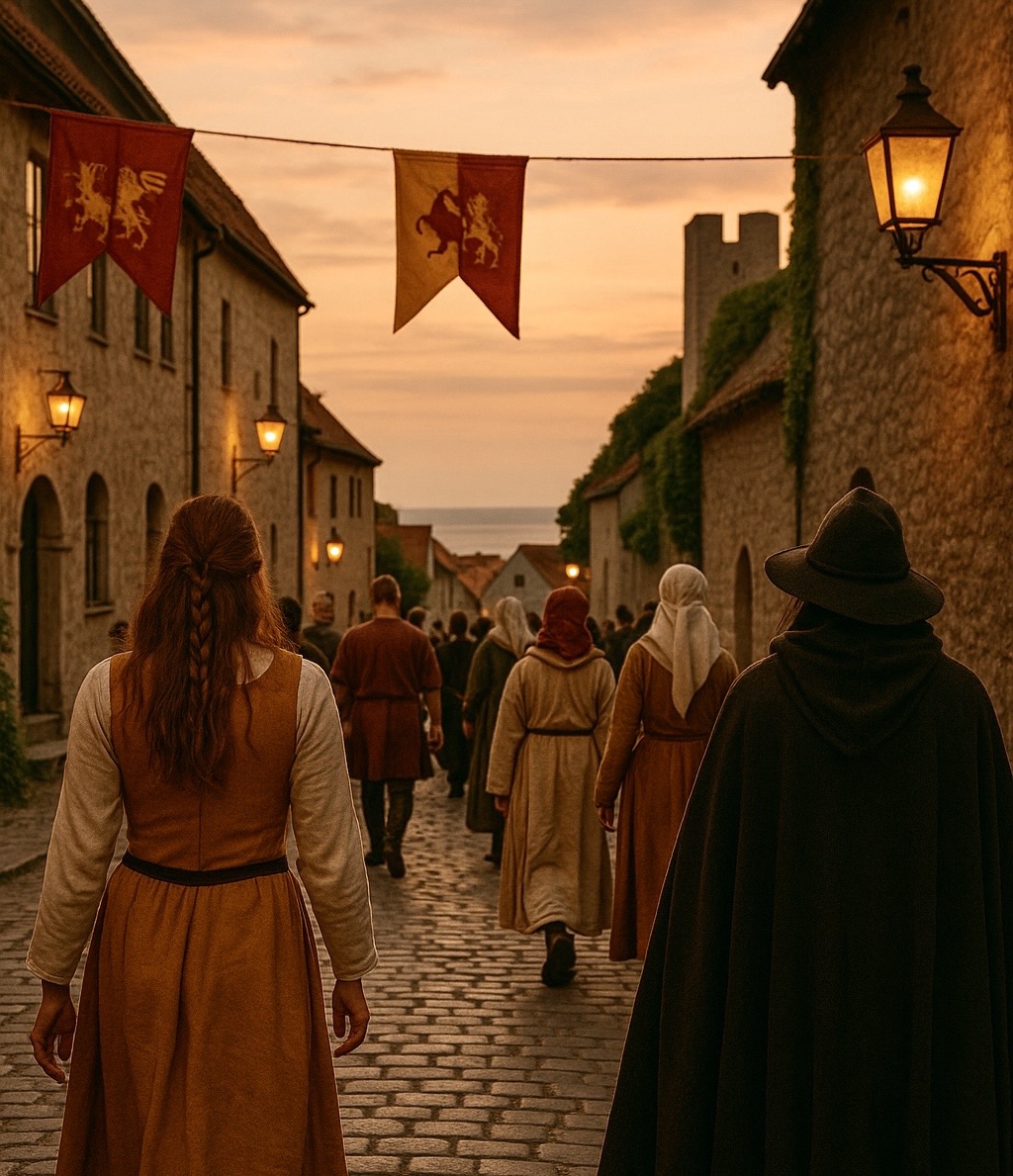
Three weeks from now, I’ll walk through the gates of Visby not as a modern visitor, but as someone stepping into another century. Cloaked, maybe slightly sunburnt, slightly overwhelmed, and deeply ready.
But why do we do this? Why do thousands of people dress in wool and linen and armor each August, sweating and spinning through the cobbled streets like a collective fever dream?
Because it’s not just dress-up.
It’s ritual.
Reenactment gets dismissed sometimes—as escapism, as fantasy, as a hobby for eccentrics. But it’s more than that. It’s a living archive. A way to make the past speak again—through costume, through food, through music and movement.
When we put on medieval clothes, we’re not pretending to be someone else.
We’re making space for someone else to return.
For me, it’s personal.
My mitochondrial haplogroup J1c8 traces back to ancient Scandinavian women—some buried on Gotland itself. And while I doubt my ancestors wore embroidered tunics for fun, I think they’d understand the desire to belong to a story bigger than myself.
I’m not playing make-believe.
I’m participating in remembrance.
And that’s what makes Medieval Week so magical. The boundaries between past and present blur—not in a theme park kind of way, but in a deeply human one. We walk the same streets. We carry old songs. We move through spaces where memory lives in the stone.
🇸🇪 Swedish Word of the Day: “skådespel”
Skådespel (noun): spectacle, drama, play
From skåda (to behold) + spel (play).
Used in a sentence:
Medeltidsveckan är ett skådespel av historia och hjärta.
(Medieval Week is a spectacle of history and heart.)
So no, I don’t reenact to escape the present.
I reenact to remind myself that time is a circle.
And every now and then, if we’re lucky, it folds

 Swedish Wanderlust