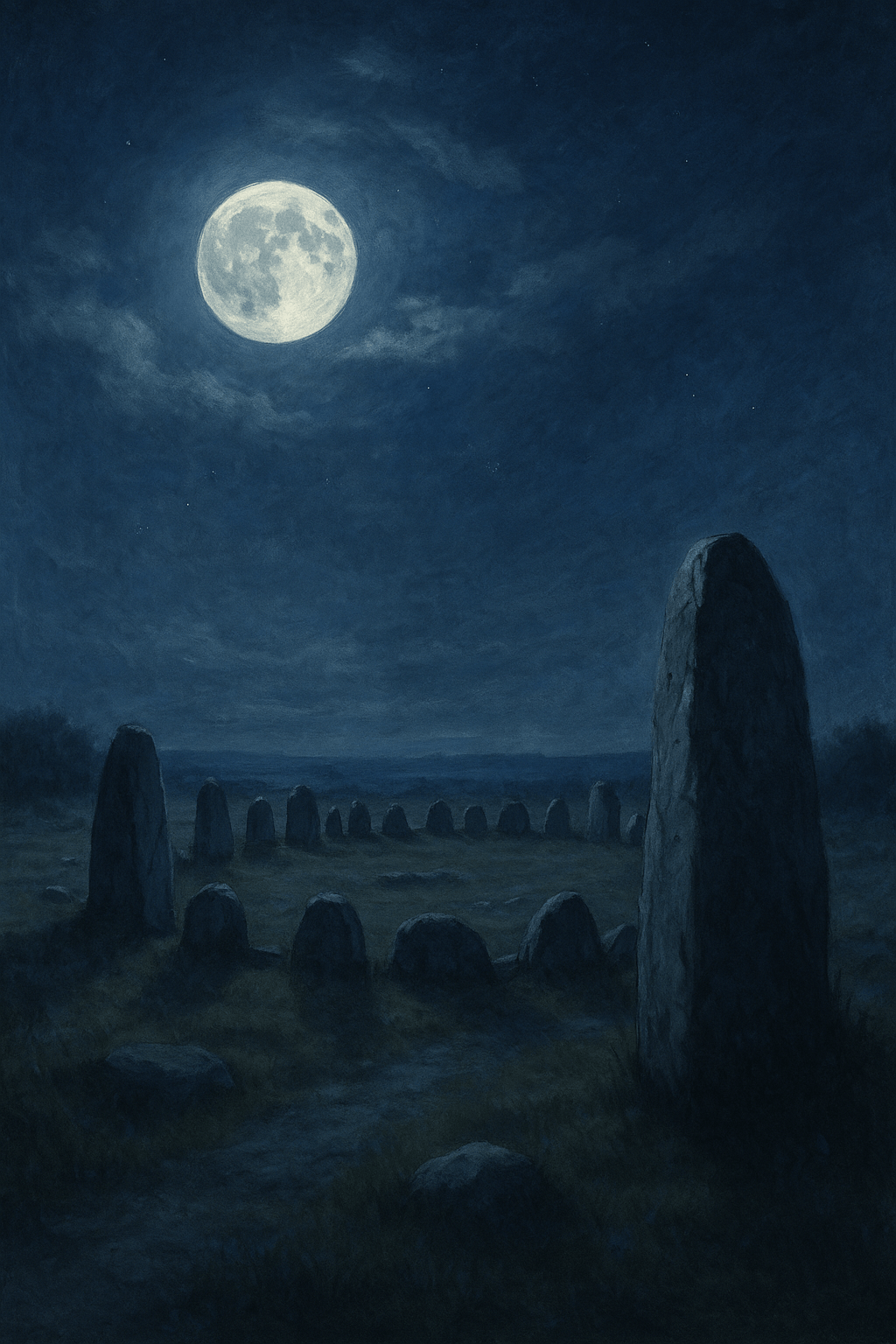
Some people say there’s something about Gotland that feels older than history.
Not just ancient, not just archaeological—but celestial.
Like the ground itself remembers a time when the stars were the only calendar, and the moon was a goddess with her own seasons.
And here’s the wild part:
That might actually be true.
🌙 The Moon in the Stones
Scattered across Gotland—especially in the southeast—are stone circles and burial fields that aren’t just decorative or symbolic.
Some researchers believe these sites were built with astronomical alignments in mind—marking the path of the moon during different points of the year.
One theory suggests that Gotland’s Iron Age grave fields may have functioned like moon temples, where rituals and burials were timed with lunar cycles.
Some stone ships and ring formations are oriented toward the moonrise during winter solstice, a time associated with death, sleep, and transition.
Imagine that:
Women standing in silence, under the longest night, saying goodbye to the dead—by moonlight.
🧬 A Feminine Alignment
The moon has always been tied to the feminine: cycles, mystery, intuition, timing.
And Gotland has always been a feminine island for me—
Matriarchal DNA (hello J1c8),
Powerful women in Fröjel graves,
And now, perhaps, sacred lunar memory etched in stone.
We often talk about Viking swords and trade routes.
But there’s another story underneath:
The rhythm of women, light, ritual, and return.
I’m not just visiting history.
I’m walking through a lunar ceremony that never really ended.
🇸🇪 Swedish Word of the Day: “måne”
Måne (noun) – moon
Used in a sentence:
Gotlands gamla stencirklar viskar till månen.
(Gotland’s old stone circles whisper to the moon.)

 Swedish Wanderlust