Podcast: Beyond the Swedish Postcard
Episode Focus: The women of the Viking Age; warriors, travelers, weavers, queens, and the ones the postcards forgot.
🎧 Listen to the Episode
🧭 Episode Summary
For more than a century, the Viking Age was told as a story of men. Episode 10 rewrites that script.
We explore:
- Grave Bj 581 – the female Viking warrior buried with sword, axe, two horses, and a gaming set. Assumed male for 140 years. DNA proved otherwise.
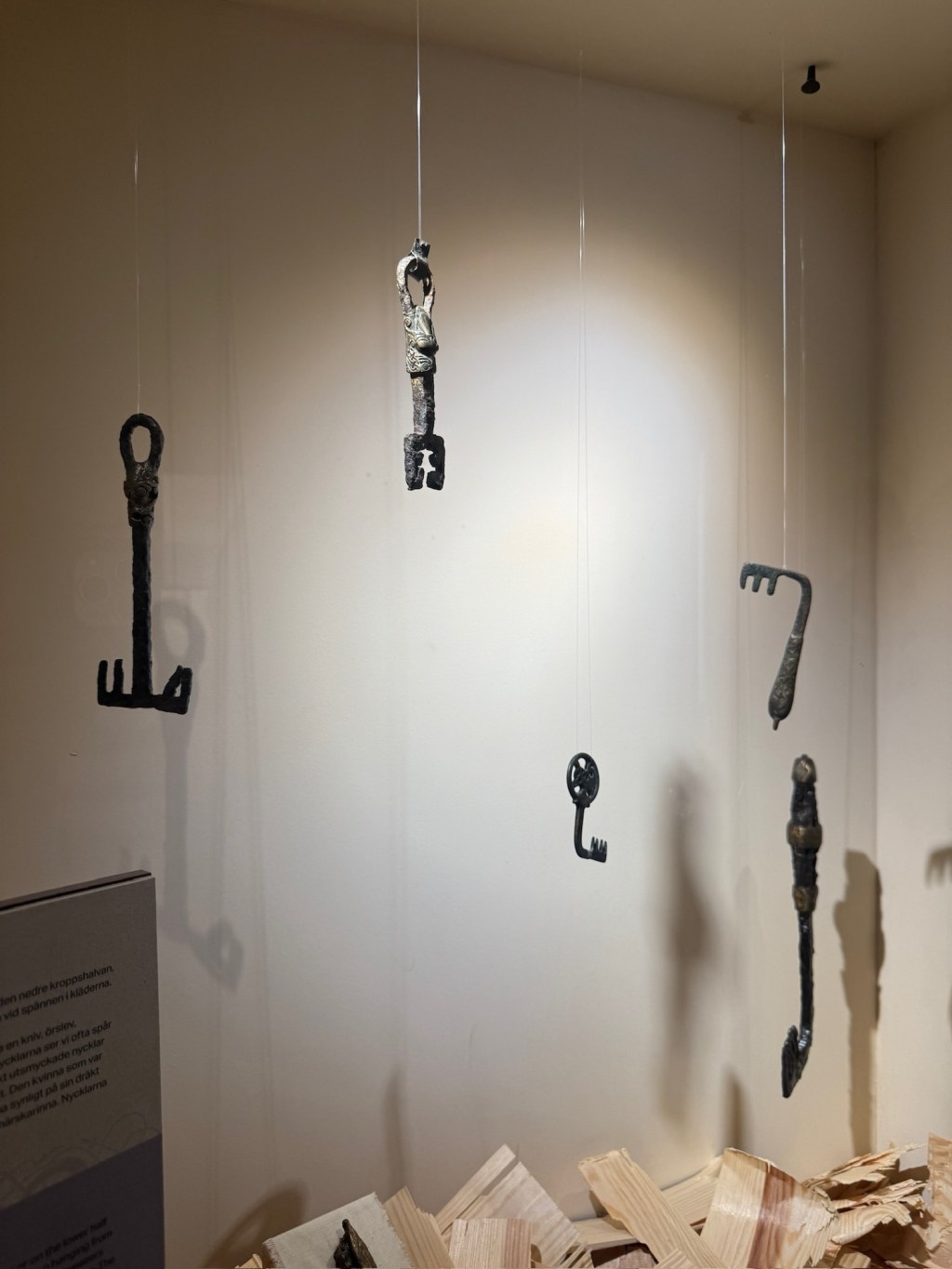
- Keys and spindles – symbols of authority and industrial-scale textile production that made Viking ships possible.
- Women who traveled – from Iceland to Greenland to Newfoundland to the rivers of the east.
- Queens and rulers – Thyra (“Denmark’s salvation”), Aud the Deep-Minded, the Oseberg ship women.
- Runestones raised by women – Gullög, Þorgerðr, and the bridges they built for souls.
- The Viking woman as a work in progress – how new scholarship is re-examining old assumptions.
- Threads in the Baltic – Personal genetic connections to Viking-era women in Gotland, Varnhem, Greenland, and a massacre victim in Oxford.
- Questions we are still asking – are we seeing Viking women clearly, or what we want to see?
📍 Places & Links Mentioned
🏛️ Gotland Museum – Visby
Display on Viking Age women: brooches, beads, keys, spindle whorls, and picture stones.
🔗 Gotlands Museum
🏺 Swedish History Museum – Stockholm
Birka collections (grave Bj 581), runestones, Catherine Sunesdotter’s tomb monument. Free entry.
🔗 Historiska museet
🏛️ Nordic Museum (Nordiska museet) – Stockholm
Artifacts from the eastern routes – silk, glass, coins from the Caliphate.
🔗 Nordiska museet
⚓ Birka – Björkö, Lake Mälaren
Site of grave Bj 581. Ferry from Stockholm (May–September).
🔗 Birka Vikingastaden
🚢 Oseberg Ship – Viking Ship Museum, Oslo
The most lavish Viking grave ever discovered – two women in a longship (834 CE).
🔗 Vikingtidsmuseet
Runestones mentioned
- Vänge Runestone (U 905) – raised by Þorgerðr (“Thor’s protection”) with a Christian cross. Outside Vänge church, Uppsala County.
- Morby Runestone – raised by Gullög for her daughter Gillög’s soul. Uppland, near Stockholm.
👑 Jelling Stones – Jelling, Denmark
Feature Queen Thyra – “Denmark’s salvation.” UNESCO World Heritage site.
🔗 National Museum of Denmark – Jelling
🪦 Catherine Sunesdotter’s tomb
On display at the Swedish History Museum, Stockholm – 13th-century queen who became legally independent as a widow.
📖 Sources & Further Reading
- Hedenstierna-Jonson, C., et al. (2017). A female Viking warrior confirmed by genomics. American Journal of Physical Anthropology.
- Price, Neil. The Viking Way: Magic and Mind in Late Iron Age Scandinavia.
- Jesch, Judith. Women in the Viking Age. – The definitive study.
- Moen, Marianne. University of Oslo – re-examining weapon burials and gender assumptions.
- Dommasnes, Liv Helga. (1998). Women, archaeologists, and the Viking Age.
- Bryman, Shanna. Making Herstory: Evaluating Female Leadership in the Viking Age. PhD candidate, University of the Highlands and Islands.
- Sawyer, Birgit. The Dead Still Speak – runestones and bridge-building.
- Project Samnordisk Runtextdatabas – Rundata entries for runestones raised by women.
🧠 Key Takeaways
- Grave Bj 581 was a female warrior – and assumed male for 140 years.
The evidence didn’t change. The assumption did. That tells us everything about bias in archaeology. - Keys were symbols of authority.
Women buried with keys managed households, controlled resources, and held economic power. - Viking sails required industrial-scale textile production.
One sail = ~10,000 hours of labor. Women’s work made the Viking Age possible. - Women traveled as far as men.
Iceland, Greenland, Newfoundland (L’Anse aux Meadows), England, and the eastern river routes. - Queens like Thyra and Aud the Deep-Minded held real power.
Thyra is named on more runestones than any Viking king. Aud led a ship to Iceland and claimed land. - Runestones raised by women are not anomalies.
Gullög raised a stone for her daughter. Þorgerðr (“Thor’s protection”) raised a Christian cross. They had wealth, status, and voice. - The past is not a mirror.
We must be careful not to project modern hopes onto Viking women. But we also must stop assuming the absence of women just because we weren’t looking.
💬 Quotes
“A grave that had been a warrior grave for 140 years was questioned the moment people realized the person inside it was a woman. Not because the evidence changed. Because the assumption changed.”
“She was not an anomaly. She was not an exception. She was a woman of the Viking Age, buried as she lived – with honor, with weapons, with the full recognition of her community.”
“The keys she held unlocked chests and doors and storage rooms. But they also unlock something else. A different way of thinking about history.”
“She is not a footnote. She was never a footnote. We just weren’t looking.”
🔗 Personal Note
In this episode, I share something deeply personal: genetic matches to Viking-era women.
“A woman from the Vendel period on Gotland. A woman from the Viking Age harbor at Fröjel. A dozen women from the cemetery at Varnhem. A settler in Greenland. A victim of a massacre in Oxford. These are not names. They are echoes. Threads. Connections that the ground has preserved and that DNA has revealed.”
These matches include VK429 (Gotland, ~975 CE), lau001 (Vendel period Gotland), over a dozen women from Varnhem (11th century), a Greenland settler (VK1) , and a victim of the St. Brice’s Day Massacre (VK166) in Oxford (1002 CE).
“The threads run through the Baltic. Through Gotland. Through Varnhem. Through Jämtland. Through Greenland. Through Oxford. And they run through me.”
🔁 Share the Episode
If this episode resonated with you:
- 🎧 Follow the podcast so you don’t miss the next one
- 📤 Share with a friend who loves Viking history or women’s history
- ✍️ Leave a review – it helps others find the show
🎙️ Coming Next Episode
Episode 11 – The Formation of Sweden
How petty kingdoms became a kingdom. How the thing became law. How the people in this landscape began to imagine themselves as Svear, Götar – and finally, Sverige. Sweden.
🏁 Final Thought
“Imagine a woman standing on the shore of Lake Mälaren, in the town of Birka, in the ninth century. She is wearing a woolen dress held up by bronze brooches. In her hand, a key. In her other hand, a spindle. She is watching ships leave for the east. She is making decisions that will shape the lives of everyone who depends on her. She is not a footnote. She was never a footnote. We just weren’t looking. But we are looking now.”
Until next time, keep looking beyond the Swedish postcard.

 Swedish Wanderlust