Podcast: Beyond the Swedish Postcard
Episode Focus: The final collapse of the Kalmar Union – from Engelbrekt’s assassination in 1436 to Gustav Vasa’s coronation in 1523. The Stockholm Bloodbath, the fugitive in the snow, and the birth of modern Sweden.
“Power consumes. Empires consume. And Gustav Vasa consumed a whole union and built a nation from its bones.”
🎧 Listen to the Episode
📖 Episode Summary
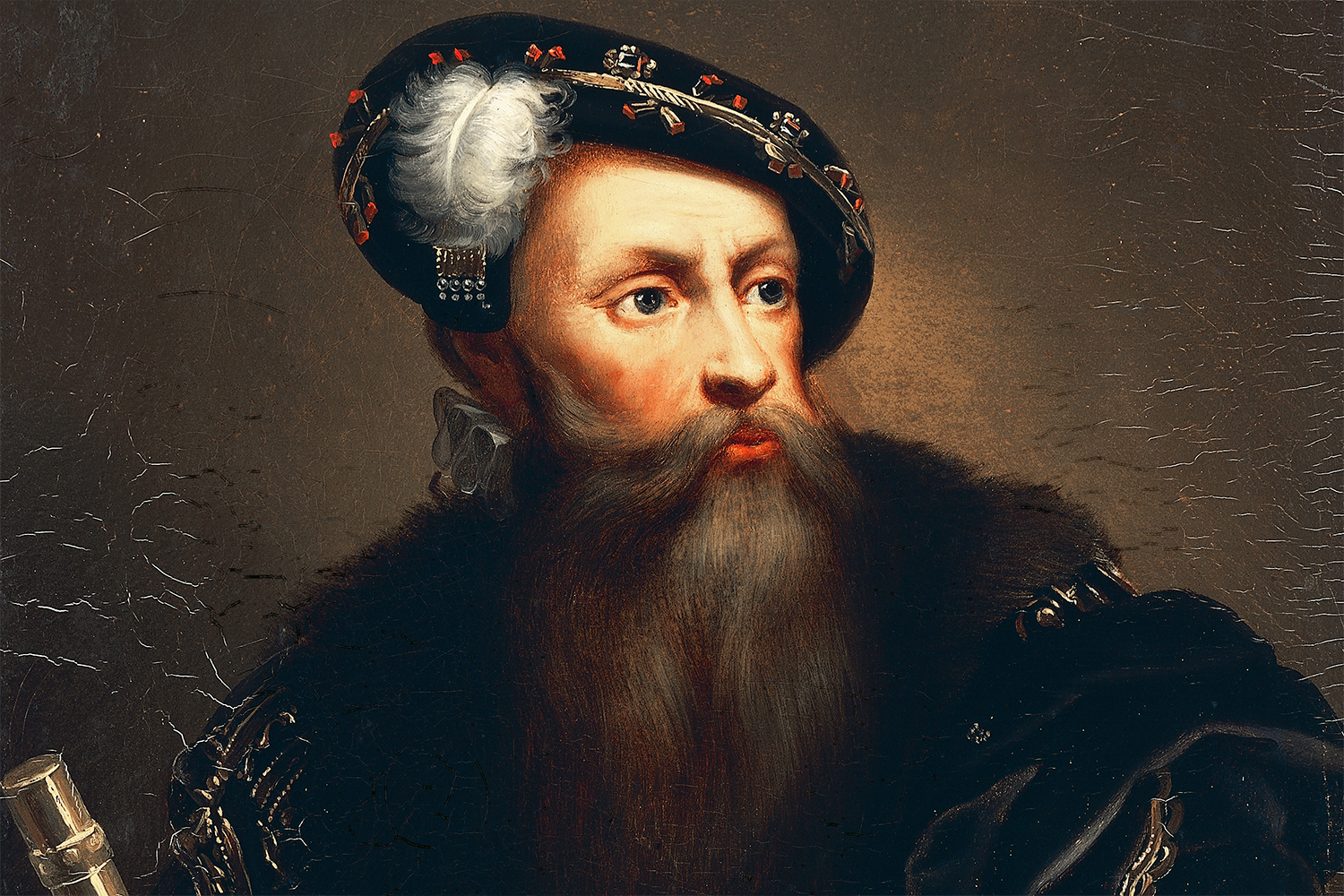
June 6, 1523. Strängnäs Cathedral. A man in his late twenties, tall, with a full beard and intense eyes, stands before the altar. The Archbishop places the crown on his head. The gathered nobles kneel. The choir sings.
The Kalmar Union is dead. Sweden is independent.
But the road from Engelbrekt’s assassination to this cathedral was long, bloody, and anything but straight. This episode traces that journey:
- The union after Engelbrekt – Eric of Pomerania deposed, Christopher of Bavaria’s brief compromise
- Karl Knutsson Bonde and the revolving door – elected king three times, deposed twice
- The Stockholm Bloodbath (1520) – Christian II’s massacre of Swedish nobles, bishops, and burghers
- The fugitive – Gustav Vasa escapes, learns his father is dead, flees to Dalarna
- The war of liberation – peasants and miners rise again, castle by castle
- June 6, 1523 – Gustav Vasa elected king, Sweden’s National Day
- What kind of king? – builder of the modern state, but also a tyrant
- The legacy of the rupture – Nordic unity still flickers, but Sweden stands alone


📍 Places Mentioned
Strängnäs Cathedral – Strängnäs, Sweden
Where Gustav Vasa was elected King of Sweden on June 6, 1523. The Kalmar Union ended here. The cathedral still stands.
Stockholm – Stortorget (Main Square)
The site of the Stockholm Bloodbath (November 7–8, 1520). Between 80 and 100 people were executed here on Christian II’s orders. The cobblestones ran red.
Dalarna – Central Sweden
The region where Gustav Vasa fled after learning of his father’s death. The peasants of Dalarna initially refused to support him, then changed their minds. The Vasaloppet ski race commemorates his legendary flight.
Mora – Dalarna
The town where Gustav Vasa pleaded with the peasants. According to legend, they said no – then sent messengers on skis to bring him back. The Vasaloppet finishes here.
Sälen – Dalarna
The starting point of the Vasaloppet. A ski resort today.
Bogesund – Lake Åsunden
Where Sten Sture the Younger was hit by a cannonball in 1520. He died of his wounds a few days later.
📖 Sources & Further Reading
Primary sources:
- Coronation documents from Strängnäs (1523)
- Contemporary chronicles of the Stockholm Bloodbath
Secondary sources:
- Lönnroth, Erik. Sveriges historia: Från Kalmarunionen till Gustav Vasa
- Harrison, Dick. Sveriges historia: Medeltiden
- Harrison, Dick. Gustav Vasa (biography)
- Larsson, Lars-Olof. Gustav Vasa – landsfader eller tyrann?
- Englund, Peter. various works on early modern Sweden
- Nordberg, Michael. I kung Magnus tid
🧠 Key Takeaways
1. Engelbrekt’s crack never fully healed.
The rebellion of 1434 showed that the Kalmar Union was not an unchangeable fact of nature – it was a political arrangement that could be renegotiated or broken.
2. Eric of Pomerania was deposed in 1439.
He fled to Gotland and became a pirate. Literally. A cautionary tale in a crown. He died in 1459, outliving his relevance by decades.
3. Christopher of Bavaria compromised – then died young.
He accepted the Swedish Council as a genuine partner. But he died at 32 with no heir, and the union was thrown back into chaos.
4. Karl Knutsson Bonde was king of Sweden three separate times.
Elected in 1448, deposed in 1457, elected again in 1464, deposed again in 1465, elected a third time in 1467, died on the throne in 1470. Exhausting.
5. The Stockholm Bloodbath (1520) changed everything.
Christian II of Denmark executed between 80 and 100 Swedish nobles, bishops, and burghers after a coronation banquet. Sten Sture the Younger’s body was dug up and burned. His wife, Kristina Gyllenstierna, was imprisoned.
6. Gustav Vasa was not in that banquet hall.
He was a hostage in Denmark. He escaped. He fled across Denmark, across the Baltic, and made his way back to Sweden – only to learn his father was among the executed.
7. The peasants of Dalarna initially said no.
Gustav pleaded with them. They were skeptical. He left, heading for Norway to flee the country. Then a messenger caught up with him on skis – the peasants had changed their minds.
8. That moment became the founding myth of modern Sweden.
It’s commemorated in the Vasaloppet, the world’s oldest and longest cross-country ski race (90 km from Sälen to Mora). Swedes do it for fun.
9. The war of liberation took two and a half years.
Castle by castle, town by town. Gustav’s army was mostly peasants and miners – just like Engelbrekt’s. But Gustav had a clear goal: end the union, not reform it.
10. June 6, 1523 – Gustav Vasa was elected King of Sweden at Strängnäs Cathedral.
The Kalmar Union was dead after 126 years. Sweden has been independent ever since.
11. June 6 is Sweden’s National Day – two reasons.
First: Gustav Vasa’s election (birth of the Swedish state). Second: the 1809 constitution (birth of modern Swedish democracy). It became a public holiday in 2005.
12. Gustav Vasa was a builder – and a tyrant.
He created the modern Swedish state: centralized administration, standing army, reformed church, hereditary monarchy. He also crushed dissent ruthlessly – executing peasant leaders who had put him on the throne.
13. The historian Peter Englund calls him “a Renaissance prince in the worst sense.”
A man who believed he answered to no one, who used violence as a tool of policy, who saw his subjects as resources to be managed.
14. In some ways, Gustav Vasa was the king Engelbrekt had rebelled against – just wearing a Swedish crown.
The peasant who fought for a voice in government was replaced by a king who believed the government was his voice alone.
15. The idea of Nordic unity never really died.
Denmark and Norway remained united until 1814. Sweden and Norway shared a king until 1905. The Nordic Council, passport-free travel, and cultural ties remain. The dream Margareta had in 1397 still flickers – quietly.
💬 Quotes
“Power consumes. Empires consume. And Gustav Vasa consumed a whole union and built a nation from its bones.”
“Christian II probably thought he was solving his Sweden problem. He was wrong. He had just created Gustav Vasa.”
“The Vasaloppet – 90 kilometers. People do it for fun. I cannot explain this. Swedes are Swedes.”
“The country Gustav Vasa founded celebrates its birthday by being aggressively relaxed about it. I kind of love that.”
“In some ways, Gustav Vasa was the king Engelbrekt had rebelled against – just wearing a Swedish crown.”
“People are complicated. Heroes doubly so.”
“The dream Margareta had in 1397, the dream Engelbrekt cracked open, the dream Gustav Vasa ended in 1523 – it still flickers. Quietly. In the background.”
🗣️ Pronunciation and Meanings Guide
- Gustav Eriksson Vasa – GOO-stahv EH-rik-son VAH-sah
- Strängnäs – STRENG-nohss
- Kalmar Union – KAL-mar YOO-nee-on
- Engelbrekt Engelbrektsson – ENG-el-brekt ENG-el-brekt-son
- Eric of Pomerania – EH-rik of Pom-er-AY-nee-ah
- Christopher of Bavaria – KRIS-toh-fer of Bah-VAH-ree-ah
- Karl Knutsson Bonde – KARL KNOOT-son BON-deh
- Christian II – KRIS-tee-an (Swedish pronunciation)
- Kristina Gyllenstierna – KREE-stee-nah YIL-en-shehr-nah
- Sten Sture – STAYN STOO-reh
- Stockholms blodbad – STOCK-holms BLOOD-bahd
- Befrielsekriget – beh-FREE-el-seh-kree-get
- Dalarna – DAH-lahr-nah
- Vasaloppet – VAH-sah-lop-et
- Sälen – SAY-len
- Mora – MOO-rah
- Regeringsformen – reh-GEH-rings-fawn-en
- Konsumtion – kon-soom-SHON
- Jag ska handla mat på mataffären, och sen ska jag promenera i skogen. Efter det ska jag plugga. Ha en bra vecka. (I’m going to do some grocery shopping at the grocery store, and then I’m going to take a walk in the woods. After that, I’m going to study. Have a good week.)
- Hej då – HAY doh (means goodbye)
🔁 Share the Episode
If this episode moved you – if it made you think differently about power, about nations, about how Sweden became Sweden:
- 🎧 Subscribe so you don’t miss the next episode
- 📤 Share with a friend who loves history or is learning about Sweden
- ✍️ Leave a review – it helps others find the show
🎙️ Coming Next
Episode 19 – The Reformation Comes to Sweden
Gustav Vasa tightens his grip. The Catholic Church’s lands are seized. Lutheranism becomes the state religion. And Sweden starts to look more and more like the Sweden we recognize today.
That’s next time.
🏁 Final Thought
“Gustav Vasa consumed the Kalmar Union. He consumed the Catholic Church’s lands. He consumed the patience of the peasants who had put him in power. And he built a nation from everything he consumed. That nation is the one I’m living in now, the one I’m trying to understand one episode at a time.
I did well on my tests last week. Small steps. I can talk about where I live and what I buy and a little bit about what I do on my free time. This podcast is my free time. And honestly, that feels right. Understanding this place – its history, its myths, its heroes and its bloodbaths – that’s not homework. It’s how I’m making Sweden my home.”
Until next time, keep looking beyond the Swedish postcard.
— JB
Beyond the Swedish Postcard

You must be logged in to post a comment.