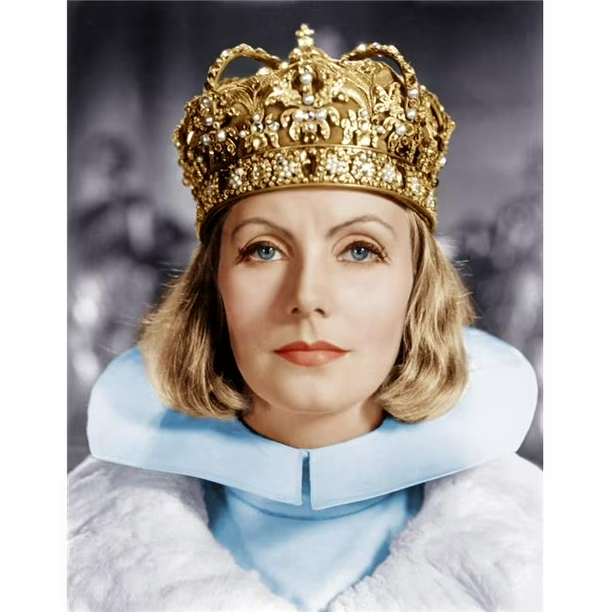
Episode Focus: The story of Queen Christina of Sweden, the child who was raised as a prince, the philosopher-queen who refused to marry, the ruler who gave away a crown, and the woman who converted to Catholicism and walked away from everything.
“Queen Christina looked at one of the most powerful thrones in Europe and decided it wasn’t worth losing herself.”
🎧 Listen to the Episode
📷Images


📖 Episode Summary
Uppsala Castle, June 6, 1654.
The room is filled with the most powerful people in Sweden. Hundreds of candles flicker against the stone walls. At the center stands a woman of twenty-seven. Queen Christina inherited the throne as a child after her father died on a battlefield. She ended the war that made Sweden a great power. She filled her court with philosophers. She rejected every prince Europe offered her.
And today, she is going to give away a crown that millions would have killed to wear.
Piece by piece, the symbols of her identity are removed. The crown. The ermine mantle. The scepter. The orb. The sword. Everything that made her Queen Christina disappears. She had prepared a speech. But when she opens her mouth, nothing comes. The woman who debated Europe’s greatest philosophers breaks down and cries openly before the entire Swedish court.
Then she walks out of Sweden – and into a future no one could have predicted.
This episode explores:
- The birth that deceived everyone – Queen Christina’s father, Gustavus Adolphus, believed she was a son
- The heart in the silver box – losing her father at six, her mother’s unraveling
- The education of a king – raised like a prince, trained to rule
- The aversion to marriage – refusing every prince Europe offered
- The queen in men’s clothing – identity, gender, and the question of Ebba Sparre
- The Athens of the North – Christina’s intellectual court, the invitation to Descartes
- The philosopher in the freezer – René Descartes’ death in Stockholm
- The secret conversion – her journey toward Catholicism
- The abdication – June 6, 1654, Uppsala Castle
- The Roman years – conversion, the Vatican, and her death beneath St. Peter’s
📍 Places Mentioned
Uppsala Castle – Uppsala, Sweden
The site of Queen Christina’s abdication on June 6, 1654. The Hall of State where she removed her crown and walked away from power. The castle still stands today.
Tre Kronor Castle – Stockholm, Sweden
The royal palace where Queen Christina was born (December 8, 1626) and raised. Burned down in 1697. Today, the Royal Palace stands on the same site.
Lützen – Saxony, Germany
The battlefield where Gustavus Adolphus died in November 1632. Christina was six years old.
Riddarholmen Church – Stockholm, Sweden
The burial church of Swedish monarchs. Gustavus Adolphus rests here. Christina is not – she is buried in Rome.
Stockholm, Sweden
The capital where Descartes spent his final winter.
Rome, Italy
Where Christina converted, lived, and died. She is buried beneath St. Peter’s Basilica in the Vatican Grottoes – one of only a handful of women to receive that honor.
Vatican Grottoes – St. Peter’s Basilica, Rome
Christina’s final resting place. Visitors can descend to see her tomb.
Fontainebleau – France
Where Christina ordered the execution of Monaldeschi in 1657.
Innsbruck – Austria
Where Christina publicly declared her conversion to Catholicism on November 3, 1655.
📖 Sources & Further Reading
Primary sources:
- Christina’s autobiographical writings
- Christina’s collected letters (including correspondence with Ebba Sparre)
- Contemporary accounts of the abdication (1654)
- Vatican archival material on her conversion and burial
Secondary sources:
- Buckley, Veronica. Christina, Queen of Sweden: The Restless Life of a European Eccentric
- Stolpe, Sven. Kristina: Drottning av Sverige (in Swedish)
- Harrison, Dick. Sveriges historia: Stormaktstiden
- Englund, Peter. Ofredsår
- Various scholarly articles on Christina’s gender identity and the Ebba Sparre relationship
Online resources:
- Vasa Museum archives – context on the dynasty
- Swedish National Archives – Christina’s letters
- Vatican Archives – conversion and burial records
🧠 Key Takeaways
1. Queen Christina was raised as a prince.
When she was born on December 8, 1626, the midwives initially declared her a boy. When the mistake was discovered, Gustavus Adolphus laughed and said, “She will be clever. She has already deceived us all.” He ordered her educated like a prince – not a princess.
2. She lost her father at age six.
Gustavus Adolphus died at the Battle of Lützen (1632). His heart was removed during embalming and placed in a silver box. Christina’s mother, Maria Eleonora, kept it close to her for years, retreating into grief and darkness.
3. Queen Christina was educated by Axel Oxenstierna.
She studied Latin, Greek, Hebrew, French, German, Dutch, Italian, Spanish. She read Plato and Aristotle in the original Greek. She studied theology, philosophy, politics, economics, astronomy, and military history. She became one of the most educated people in Europe – not one of the most educated women.
4. Queen Christina never married.
She said in her autobiography, “I have an insurmountable aversion to marriage.” She refused every European prince who pursued her. She named her cousin Karl Gustav as her heir instead.
5. Queen Christina wore men’s clothing and rode astride.
Contemporary accounts describe her deep voice, direct manner, and “the bearing of a man.” She wrote that she possessed “a man’s soul.” Modern historians debate the meaning of her identity.
6. Queen Christina loved Ebba Sparre.
Christina called her “Belle.” Their surviving letters are filled with tenderness, longing, and heartbreak. When Ebba married another man, Christina’s letters reveal unmistakable grief.
7. Queen Christina invited René Descartes to Stockholm.
She wanted Europe’s greatest philosopher to challenge her. He arrived in 1649. He died in February 1650, likely from pneumonia brought on by Stockholm’s harsh winter and Christina’s insistence on 5 AM philosophy lessons.
8. Queen Christina secretly converted to Catholicism.
Sweden was a Protestant country. The sovereign had to be Lutheran. Christina read Catholic theology, admired its philosophy and art, and began meeting secretly with Catholic priests who visited Stockholm in disguise.
9. Queen Christina abdicated on June 6, 1654.
At Uppsala Castle, piece by piece, the symbols of her monarchy were removed. She broke down in tears and could not speak for a moment. Then she walked out of Sweden – forever.
10. She converted publicly in Innsbruck.
On November 3, 1655, she formally embraced Catholicism. The Vatican celebrated her arrival with triumphs, bells, and crowds.
11. She lived in Rome for the rest of her life.
She surrounded herself with artists, musicians, philosophers, and scientists. Her palace became one of Rome’s great intellectual salons. She continued to dress in ways that made conservative observers uncomfortable.
12. She ordered an execution in France.
In 1657, at Fontainebleau, she had her official Gian Rinaldo Monaldeschi executed without a formal trial. She believed he had betrayed her. Europe was horrified.
13. She died in 1689 at age sixty-two.
Nearly thirty-five years after leaving Sweden, she died in Rome. She was buried beneath St. Peter’s Basilica in the Vatican Grottoes – one of only a handful of women to receive that honor.
14. Why Christina matters now.
She spent her entire life asking who gets to decide who she is. Her struggle between expectation and identity, between duty and conscience, between belonging and authenticity – those are timeless questions.
15. She remains one of history’s most fascinating contradictions.
Brilliant, stubborn, courageous, impulsive, generous, ruthless, intellectually voracious, emotionally complex. She refused to fit into the boxes her society built for her.
💬 Quotes
“She looked at one of the most powerful thrones in Europe and decided it wasn’t worth losing herself.”
“The crown is lifted from her head. The ermine mantle is unclasped from her shoulders. The scepter leaves her hand. Piece by piece, everything that made her Queen disappears.”
“What kind of person willingly gives up absolute power? More importantly – what kind of life makes someone believe that giving up everything is the only way they can finally become themselves?”
“She had spent her entire life being educated to rule. Why would she voluntarily surrender that?”
“If you’re the most famous philosopher in Europe, and the Queen of Sweden personally invites you to her court – do you say no? René Descartes didn’t. And that decision would prove fatal.”
“Christina spent her entire life asking one question: who gets to decide who I am? Her family? Her advisers? The Church? Society? Or herself?”
“History doesn’t always give us heroes. Sometimes it gives us people who are brilliant, frustrating, courageous, contradictory, and deeply human.”
“Most of us will never wear a crown. But all of us, at some point, will face a moment when who we are collides with who the world expects us to be.”
🗣️ Pronunciation Guide
- Christina – kris-TEE-nah (Swedish) / kris-TEE-nuh (English)
- Gustavus Adolphus – goo-STAH-vus ah-DOL-fus (English) / Gustav II Adolf (Swedish)
- Axel Oxenstierna – AHK-sel OOK-sen-shehr-nah
- René Descartes – ruh-NAY day-KART (English) / ruh-NAY dey-KART (French)
- Ebba Sparre – EB-bah SPAR-reh
- Maria Eleonora – mah-REE-ah el-eh-oh-NOR-ah
- Karl Gustav – KAHL GOO-stahv
- Lützen – LOOT-sen
- Uppsala – OOP-sah-lah
- Tre Kronor – TRAY KROO-nor
- Monaldeschi – mo-nal-DES-kee
- Fontainebleau – FON-ten-bloh
- Innsbruck – INS-brook
- Vatican Grottoes – VAT-ih-kan GROT-toes
- Riddarholmen – RID-dar-hol-men
- Hej då – HAY doh
- Tack så mycket – TAK so MICK-eh
🔁 Share the Episode
If this episode moved you – if it made you think differently about identity, about the cost of authenticity, or about the courage it takes to walk away from everything that’s familiar:
- 🎧 Subscribe so you don’t miss the next episode
- 📤 Share with a friend who loves biographies, philosophy, or stories of extraordinary women
- ✍️ Leave a review – it helps others find the show
🎙️ Coming Next
Episode 24 – The March Across the Frozen Sea
Sweden has a new king. Karl X Gustav. Faced with an enemy on the other side of the water, he’ll do something almost unimaginable – march an army across a frozen sea. One of the boldest military decisions in European history.
That’s next time.
🏁 Final Thought
“Christina left Sweden believing she was leaving her old life behind. In many ways, she was. But history has a funny way of deciding what it remembers. It remembers the battlefield where her father fell. It remembers the throne she abandoned. It remembers the church where she found a new faith.
But I wonder if that’s really her greatest legacy.
Maybe it wasn’t the crown she wore. Or the crown she gave away. Maybe it was the courage to choose conviction over comfort. To accept that living honestly sometimes means walking away from everything that’s familiar.
That’s not just a seventeenth-century story. It’s a human story.”
Until next time, keep looking beyond the Swedish postcard.
— JB

You must be logged in to post a comment.