Podcast: Beyond the Swedish Postcard
Episode Focus: The arrival of the Black Death in 14th-century Sweden – the ghost ship, the mass death, the deserted villages, and how the plague reshaped a kingdom.
“This is the story of the deadliest pandemic in human history.”

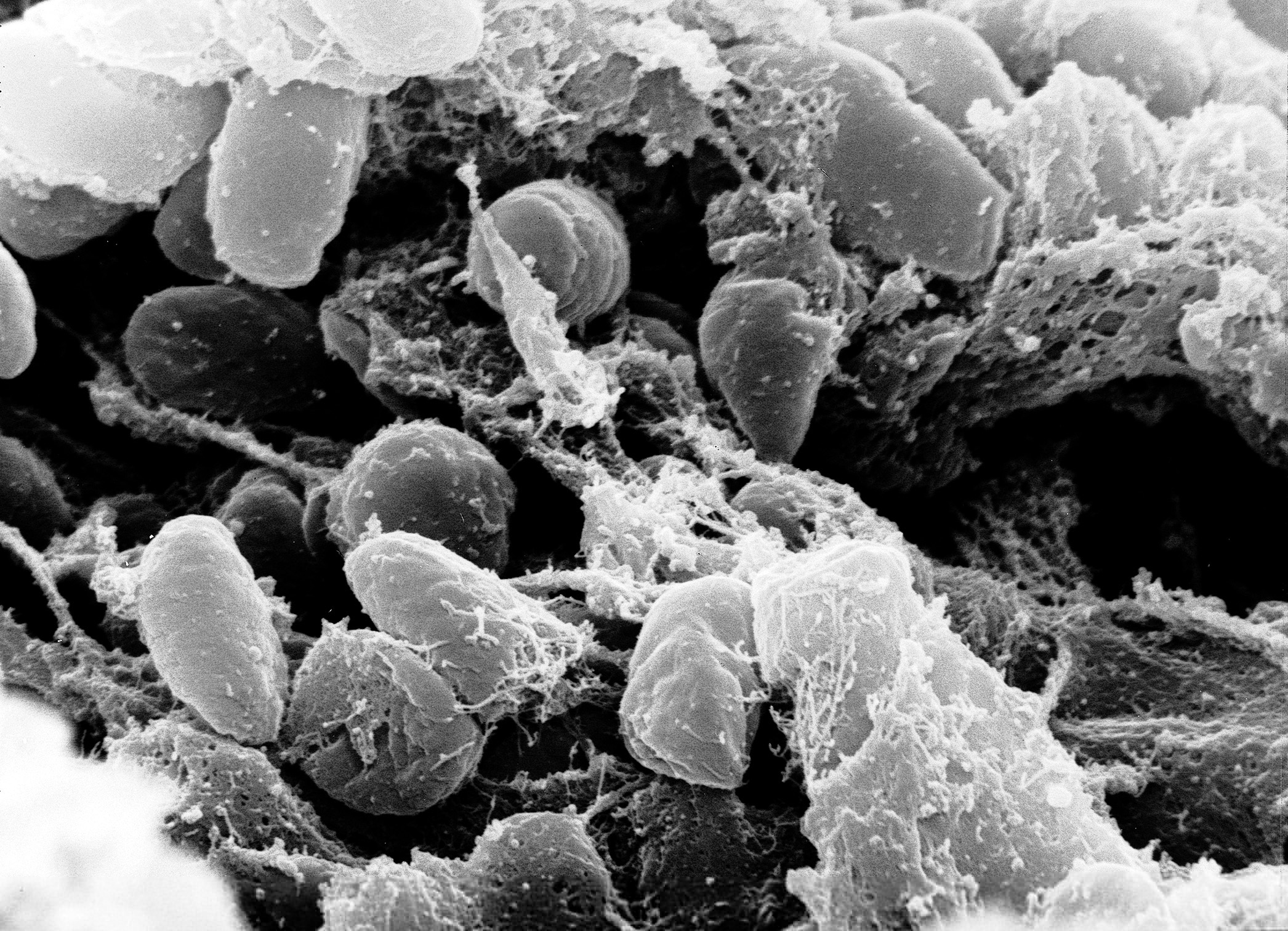
Scanning electron micrograph depicting a mass of Yersinia pestis bacteria (the cause of bubonic plague) in the foregut of the flea vector


🎧 Listen to the Episode
🧭 Episode Summary
In the summer of 1349, a merchant ship drifted into the harbor of Bergen, Norway. The crew was dead. The cargo was untouched. The ship was a tomb.
That ghost ship carried the Black Death to Scandinavia.
This episode explores:
- The invisible enemy – Yersinia pestis and the three forms of plague (bubonic, pneumonic, septicaemic)
- How it spread – rats, fleas, and the emerging theory of human lice as primary vectors
- The road north – from the Mongol siege of Caffa to the Hanseatic League to Visby
- What it felt like – the texture of daily life when death was everywhere
- The landscape of death – ödegårdar (deserted farms) and villages swallowed by forest
- What survived – Sweden’s free peasantry, leverage after the plague, and why Sweden didn’t get serfdom
- The silence of God – the Church’s failure and the cracking of medieval certainty
- The aftermath – a civilization reset, and a world that would never be the same
📍 Places & Links Mentioned
🏛️ Bergen – Norway
The port where the ghost ship drifted in 1349. Today a UNESCO World Heritage city (Bryggen).
🔗 Visit Bergen
🏛️ Visby – Gotland
One of the wealthiest Hanseatic cities in the Baltic. Plague arrived here in 1350. No mass graves have been found – a mystery.
🔗 Gotland Museum (Visby)
🏛️ Kvarntorp – Östergötland
A deserted medieval village swallowed by forest. Excavated by archaeologists. Coin from the 1340s. Then nothing.
🔗 Swedish National Heritage Board
🏛️ Boda – Småland
Another ödegård – same story. Stone foundations, a hearth, then silence.
🏛️ Linköping Cathedral – Linköping
Seat of the bishop who wrote the desperate letter to his diocese in 1350.
🔗 Linköping Cathedral
🏛️ Swedish History Museum – Stockholm
Medieval collections, including artifacts from the plague period and deserted farms.
🔗 Historiska museet
📖 Sources & Further Reading
Primary sources:
- Bishop of Linköping’s pastoral letter (1350) – quoted in episode, original in Swedish National Archives
- Papal letters regarding flagellants (c. 1350)
Secondary sources:
- Benedictow, Ole J. The Black Death 1346–1353: The Complete History – the definitive study
- Ziegler, Philip. The Black Death – classic overview
- Harrison, Dick. Digerdöden: Sveriges historia 1350–1400 (in Swedish)
- Myrdal, Janken. Medeltidens åkerbruk – on deserted farms and agrarian change
Recent research on plague transmission:
- Dean, K. R., et al. (2018). Human ectoparasites and the spread of plague in Europe. Proceedings of the National Academy of Sciences.
- Spyrou, M. A., et al. (2022). Ancient Yersinia pestis genomes from the Black Death. Nature.
🧠 Key Takeaways
- The ghost ship was real. In 1349, a drifting merchant vessel entered Bergen harbor with all crew dead. Norwegians called it Svartedauden (Black Death). Swedes called it Digerdöden (Great Death).
- Three forms, one death. Bubonic (buboes, 70% mortality), pneumonic (lung plague, spread by breath, near 100% mortality), septicaemic (blood plague, killed within hours).
- Rats may not have been the main culprit. Recent research suggests human fleas and body lice were the primary vectors, especially in cold climates like Norway where black rats couldn’t survive.
- The Hanseatic League became a plague highway. Port to port, ship to ship, the bacterium traveled with grain, wool, timber – and the people who moved them.
- Visby’s dead are missing. A wealthy Hanseatic city with thousands of residents and a 50% death rate – yet no mass graves have ever been found. Where are they?
- Priests died at higher rates than anyone. They stayed. They administered last rites. They touched the dying. Some parishes lost every single priest.
- The dying died alone. That was the terror. No absolution. No last rites. No one to close their eyes.
- Thousands of farms were abandoned. Ödegårdar – deserted farms – appear on tax records as öde, vacat, mortuus. Entire villages were swallowed by forest.
- Sweden didn’t get serfdom – because of the plague. Half the workforce died. Landless laborers suddenly had leverage. They demanded better wages – and got them.
- The Church failed. The prayers didn’t work. The relics didn’t work. The flagellants didn’t work. Something cracked in the medieval worldview.
💬 Quotes
“The living are not enough to bury the dead.” – Archbishop of Nidaros
“The dying died alone. No absolution. No last rites.”
“You are the only one left in the house. You are the only one left in the village.”
“The Black Death didn’t kill God. But it killed something. Trust, maybe. Certainty. The easy, unreflective faith of the early medieval world.”
“A third of Europe died. But the Great Death wasn’t just a tragedy. It was a reset. A pivot. A moment when the trajectory of an entire civilization bent.”
“Not that long ago, we went through our own pandemic. We know what it feels like to watch the world slow to a halt. They did, after 1350. And they were never the same.”
❓ The Mystery of Visby
One of the most puzzling aspects of the Black Death in Sweden:
- Visby was a major Hanseatic port – ships from plague-infected cities arrived constantly
- The city had thousands of residents
- The death toll likely approached 50%
- Almost no mass graves have ever been found
Possible explanations:
- Bodies were buried in wooden coffins that rotted away
- Remains were cremated
- Churchyards were reused so intensively that bones were ground to dust
- A plague cemetery lies under Visby’s medieval streets – waiting to be found
The ground on Gotland keeps its secrets.
👥 The Swedish Peasant’s Exception
Unlike England (Statute of Labourers, 1351) or Eastern Europe (deepening serfdom), Sweden’s peasants emerged from the plague with more rights:
| Region | Post-Plague Outcome |
|---|---|
| England | Wages frozen; Peasants’ Revolt (1381) |
| Poland/Russia | Serfdom deepened; lasted centuries |
| Sweden | Free peasants, fixed-term leases, representation in Riksdag |
Why? The seeds were already there:
- Old thing assemblies
- Relatively weak nobility
- Scattered, forested landscape (hard to control)
- Skattebönder – freeholders who paid taxes directly to the crown
The plague didn’t create this freedom. It watered it.
🔁 Share the Episode
If this episode made you think differently about what lies beneath the surface of history:
- 🎧 Follow the podcast so you don’t miss the next one
- 📤 Share with a friend who loves medieval history or pandemic history
- ✍️ Leave a review – it helps others find the show
🎙️ Coming Next Episode
Episode 14 – Saint Birgitta of Sweden
From the silent villages and empty fields to a voice that refused to be silenced.
Mystic. Prophet. Mother of eight. The woman who buried two of her children during the plague – and then stood up and told popes and kings exactly what God thought of them.
That’s next time.
🏁 Final Thought
“A third of Europe died. In Norway, in England, in France, in the German lands. In Sweden, the death toll was likely similar – somewhere between a quarter and a half of the population. We’ll never know the exact number. The records don’t exist. The dead are silent.
But the Great Death wasn’t just a tragedy. It was a reset. A pivot. A moment when the trajectory of an entire civilization bent.
The survivors walked out of the plague years into a different world. A world with more land, more resources, more bargaining power. A world where the old rules no longer applied.
Not that long ago, we went through our own pandemic. We know what it feels like. They did, after 1350. And they were never the same.”
Until next time, keep looking beyond the Swedish postcard.

You must be logged in to post a comment.